When the Answers Are Still Emerging
Reflections from the World Finance Forum in London · September 2026
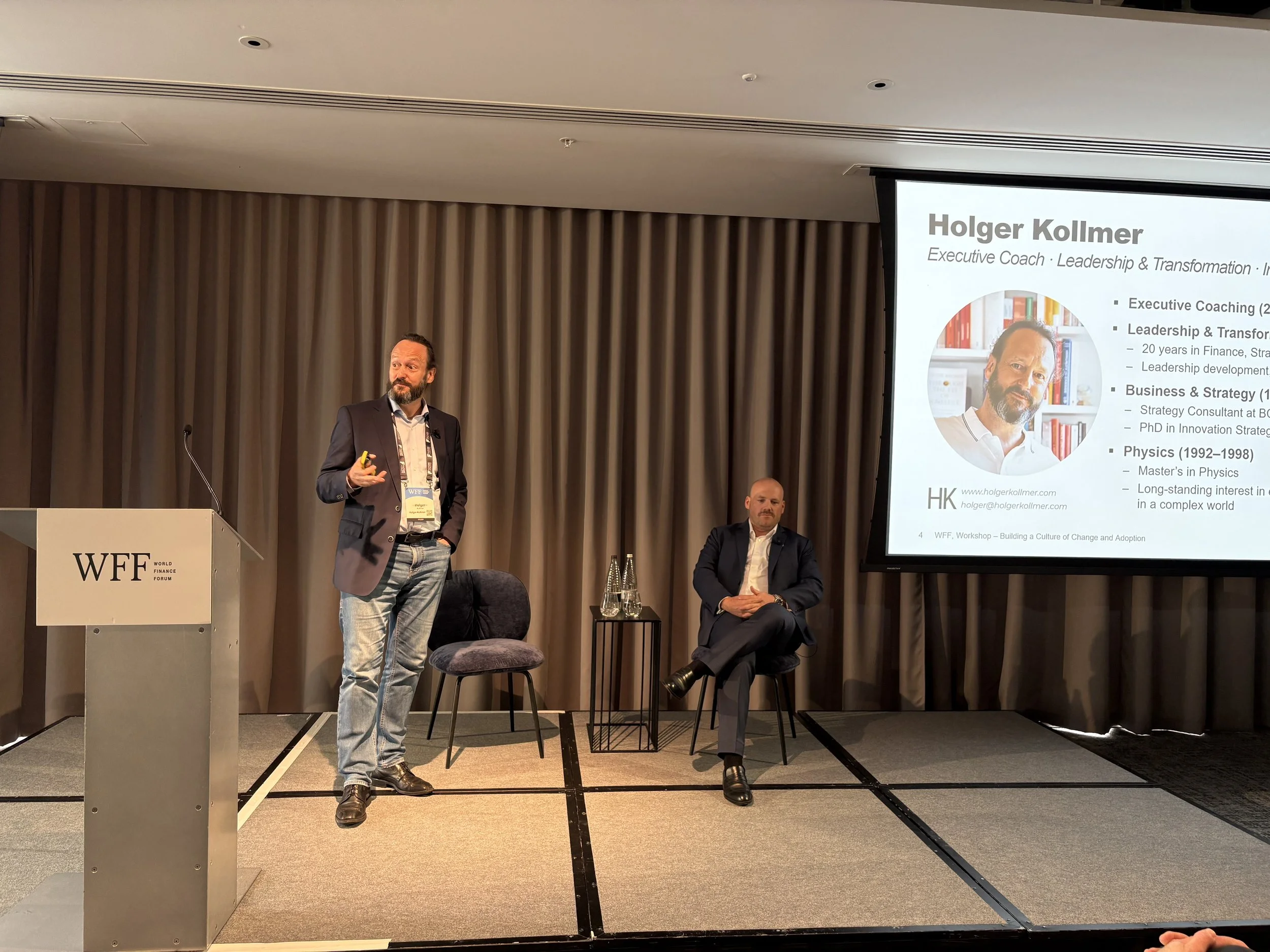
Change Adoption Workshop · World Finance Forum London · September 2026
Last week, I attended the World Finance Forum in London.
The dominant topic was not difficult to miss: AI.
Finance is changing.
Much of the conversation was about trying to understand where this is taking us and how to respond. How do we measure value creation? Where are the productivity gains? How does Finance stay in control as AI tools and investments proliferate?
And at the same time: How do we experiment, learn and move faster?
If I were still leading in Finance, I would have exactly the same questions. How do we move ahead while staying on top of what is happening?
But there was something else in the atmosphere, something in the vibe of the room. The excitement and desire to move ahead, alongside anxiety about the unknown and frustration.
The search for control.
Finance is expected to provide transparency and control, but can also quickly become the function perceived as slowing things down.
So one response I heard at the Forum was perhaps not surprising: understand where AI is already being used and where money is being spent. Establish governance. Understand whether it is actually creating value.
All very reasonable.
And yet one word kept cutting across: Experimentation.
We are not simply implementing something we already understand. We need to try things and discover what becomes possible as we use them.
But how much experimentation do you fund? How much failure do you accept? And how do you control something without constraining precisely the learning you need?
Another response I heard was much more down to earth: cut through the hype.
AI cannot do everything. Distinguish where it is useful and where it isn't. Automate what makes sense. Preserve human judgement where it matters.
It would be easy to dismiss that as too conservative.
I am not sure it is.
Perhaps helping to create clarity about what works and what does not is exactly what Finance can contribute.
And there was another side to the room. People were excited.
Finance leaders wanted to move forward. They wanted adoption. And they wanted to move faster.
And their question was simply: How do we make it happen?
Our own workshop later that day approached this question a little differently. Instead of presenting answers, we used an inquiry format and invited people in the room to explore their own transformation cases together.
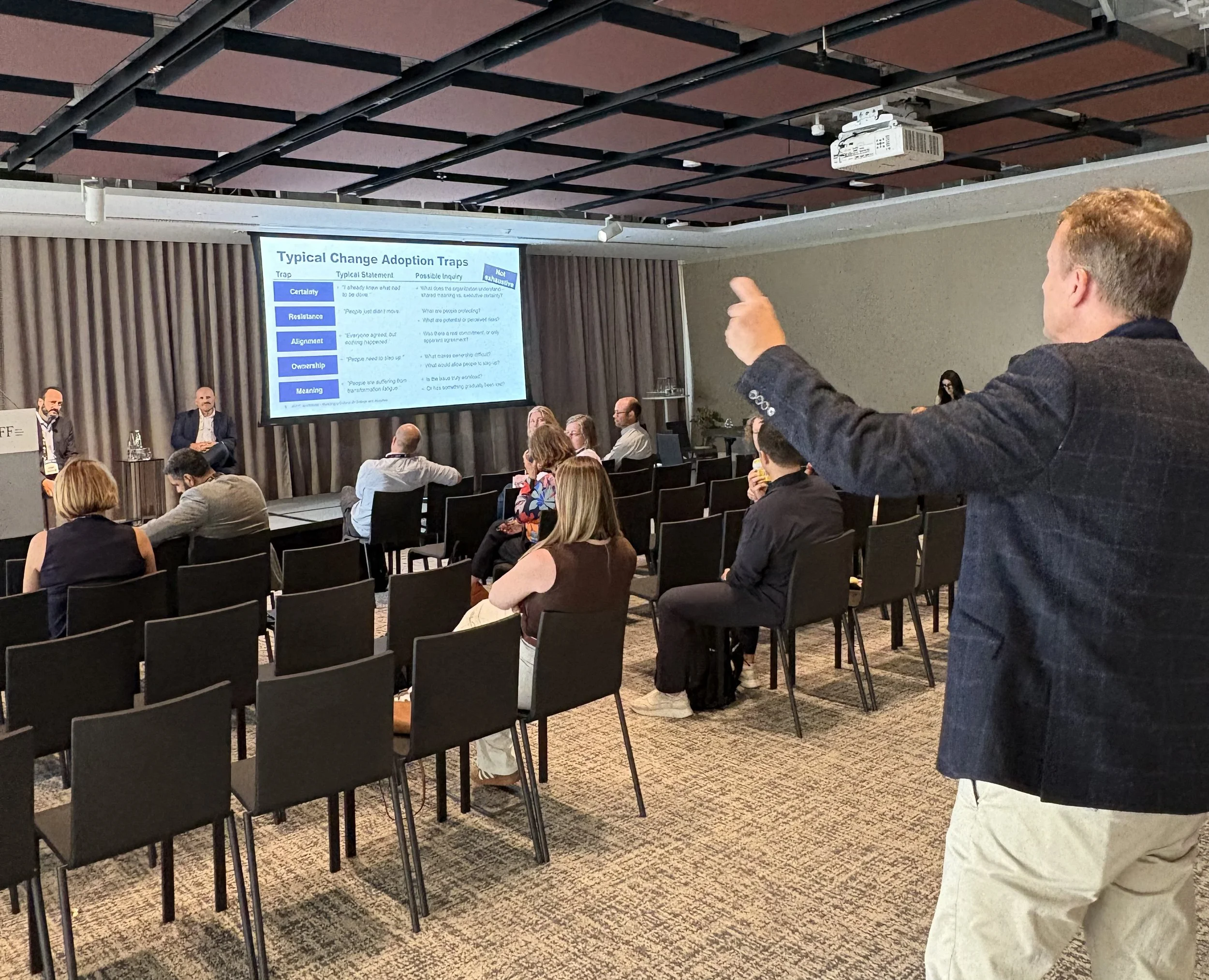
Exploring a participant’s question during the Change Adoption Workshop
One theme appeared early: find the champions.
Instead of putting all the attention on resistance, find the people already open to the change and involve them in moving it forward.
The next case was about an AI pilot with low adoption.
The leader herself loved using it. She experimented with AI every day and described what she felt simply as joy.
That word stayed with me. Joy.
Could she follow exactly that joy? Rather than focusing primarily on resistance, could she share what inspired her and invite others to explore for themselves what AI might make possible?
Another case involved engaging around 2,000 people in a major transformation.
The initial question was how to communicate the transformation. And as we explored it together, another question emerged: What do they see? What questions do they have?
Perhaps the task was not only to communicate the change, but to invite people to participate in discovering it.
Looking across these discussions, I recognised a familiar question from my Gestalt coaching practice:
Where is the energy already? Where are curiosity and experimentation already happening?
Where is all this taking us?
The deeper uncertainty is not about tools or use cases. It is about the transformation of Finance itself. Processes and ways of working will change. Roles will change. Some will disappear altogether.
We are already getting a glimpse of what that future might look like.
But much of it is still emerging.
And perhaps that is precisely the point.
How do we lead when we don't know yet?
Looking back at the conference, five thoughts stay with me.
Excitement and anxiety coexist.
AI is already opening extraordinary possibilities. At the same time, it is unsettling roles, expertise and professional identities. We do not need to resolve that tension. Both belong in the room.
Give direction without pretending to know the destination.
Decisions have to be made. Investments have to be risked. People need direction. But giving direction does not mean that we already know where AI will take us.
Have the courage not to close too quickly.
Some questions need answers now. Others may need to remain open long enough for something new to emerge. And it takes courage not to eliminate that uncertainty too quickly.
Follow the energy.
Notice curiosity, experimentation, excitement, and joy. Follow some of that energy. It may not tell us where we will end up, but it can help us discover where to go next.
Invite people into the transformation.
People's work, roles and professional identities are changing. They cannot simply be recipients of a transformation they themselves are undergoing. Invite them to participate in discovering what comes next.