Life Had Not Unfolded as They Had Wished
Reflections from a Self-Compassion Workshop
Recently I was facilitating a workshop on self-compassion. The group was small. Most of the participants were navigating a difficult period in their lives. During one of the exchanges, a participant shared something simple: “I hardly feel my body. I am always in my head.”
A little later, we moved on to the next part of the workshop. Yet her words stayed with me. A few days earlier I had come across a short exercise. I had never used it with a group before, and it was not part of the plan. Still, something about the moment felt right.
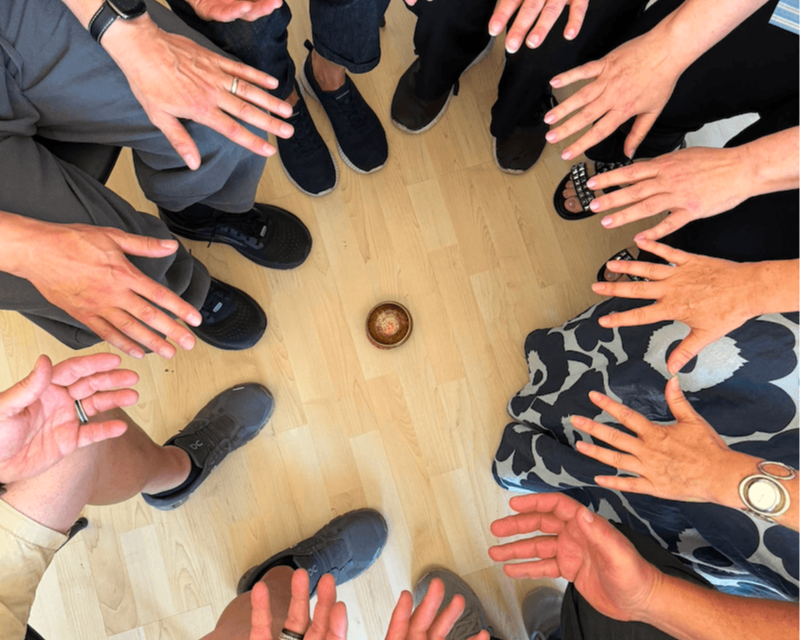
So instead of moving on, I paused. I invited everyone to place their hands on their thighs and simply notice their breathing. After a minute or so, we turned our hands over and paid attention again.
The exercise itself only lasted a minute or two, and several participants noticed a change in their breathing. That in itself was the expected reaction. What surprised me was what happened next. Something had shifted. The conversation felt different. Over the course of the morning, the atmosphere in the room seemed to become lighter an more open.
Riding my bike home later that day, I found myself wondering: What had actually happened?
What stayed with me was not the exercise itself. What stayed with me were the people I had met. In particular, I found myself thinking again about the participant and her sentence: “I hardly feel my body. I am always in my head.”
The sentence struck me because it was so real. Simple and true. Here was someone trying to navigate a difficult period in life while feeling increasingly disconnected from her own experience.
The more I thought about our exchange, the more I realised that the exercise had not emerged from nowhere. It emerged from that conversation. From listening. And from being touched by what another person was struggling with.
I also began to notice something else. In different ways, many of the people in the room had been teaching me something similar.
One participant spoke about a training program he had hoped to attend. The
application had been rejected, and the disappointment was still fresh.
Another shared that she had recently been diagnosed with a heart condition. More than her own worries, she seemed touched by the concern it had triggered in her children.
A third participant spoke about the tension between her drive for action and her need to slow down. Going for a walk. Resting. Listening to her body. And the familiar voice that immediately questioned whether she had done enough.
The details were different. Yet as I reflected on the conversations afterwards, I found myself noticing a common thread. None of these people were pretending that life was easy. Each of them was carrying something real: a disappointment, an illness, or an inner struggle that seemed difficult to escape.
They came to the workshop. They shared their stories. They listened to one another. They reflected, explored new perspectives, and occasionally laughed together. Life had not unfolded as they might have wished. And yet life was still unfolding. Not the life they had planned, perhaps, but the life that was now in front of them.
Toward the end of the workshop, we were about to move into the final exercise. At that point, a participant who had spoken very little throughout the morning shared something from her own life.
When difficult emotions or challenging situations arise, she said, she often turns to a simple image: standing under a shower or swimming in the sea. Not as a way of escaping from the situation, but as a way of staying with it more gently. Looking at it with kindness rather than fighting it. That changes things. She often feels lighter afterwards. More relaxed. Better able to face whatever is in front of her.
Then she paused and turned back to us. At the beginning of the morning, she said, the atmosphere in the room had felt heavy. Now it felt different. Lighter. The conversation that followed became a shared reflection on what had happened during the morning. Nobody suggested that their problems had disappeared. Yet something had shifted.
I began to wonder whether there was a common thread running through all of these experiences. Throughout the workshop, we had encountered something real. A participant's struggle to feel her body. A disappointment. An illness. Exhaustion. Self-doubt. Rather than moving quickly past these moments, we stayed with them. Sometimes this meant changing direction. Sometimes it meant sharing a different perspective.
Sometimes it simply meant listening a little longer. From these encounters, something new seemed to emerge. The difficulties themselves had not disappeared. Life had not unfolded as people had wished. And yet they continued to engage with it.
Perhaps this was what had touched me so deeply that morning. Not that we had solved anyone’s problems. We hadn’t. The external situations had not changed. But the way people related to them had.
As difficult as life can sometimes be, there is something deeply human in that. The ability to meet life as it is—not as we wish it to be—and still remain engaged with it. And that is beautiful.